
Backlink Analysis & Link-Building Strategies | Acton Engineers
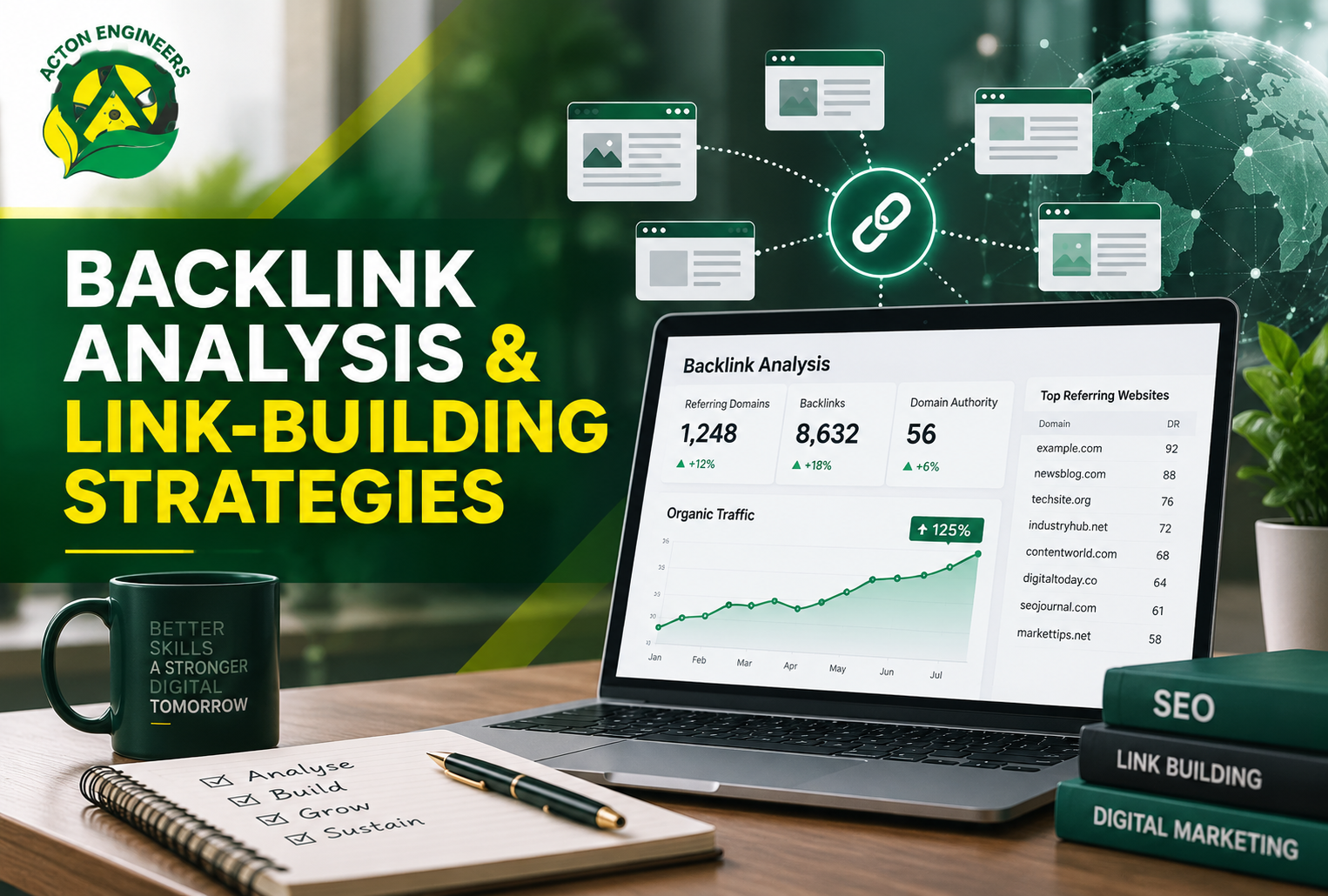
Backlink Analysis and Link-Building Strategies: A Practical SEO Guide
Backlinks are often discussed as if they were votes: collect enough of them and rankings will improve. In practice, links are far more complicated. One relevant citation from a respected industry publication may be more useful than hundreds of links from unrelated directories, automated profiles or abandoned websites.
Backlink analysis is therefore not a link-counting exercise. It is the process of examining who links to a website, why the link exists, which page receives it and whether it contributes to authority, referral traffic or brand discovery.
For anyone working in Digital Marketing, this distinction matters. A successful strategy must balance authority building with relevance, editorial credibility and measurable business value. This guide explains how to audit a backlink profile, evaluate competitors and build links without depending on risky shortcuts.
What Is Backlink Analysis?
Backlink analysis is the systematic review of external links pointing to a website or individual page. It reveals the strengths, weaknesses and patterns within a site’s off-page SEO profile.
A useful analysis examines:
- Referring domains and referring pages
- Relevance of the linking website
- Authority and organic visibility of the source
- Link placement and surrounding context
- Anchor-text distribution
- Followed and nofollow attributes
- Target-page distribution
- New and lost links
- Suspicious or manipulative patterns
- Referral visits and assisted conversions
Google uses links to discover pages and understand relationships between online resources. Its official link best practices also emphasise crawlable links and descriptive, natural anchor text.
However, a backlink should never be judged by one metric alone. Domain Authority, Domain Rating and similar scores are estimates created by third-party tools not measurements used directly by Google.
Why Backlinks Matter in Digital Marketing
Backlinks can support several parts of Digital Marketing simultaneously. A well-placed link can strengthen organic visibility, introduce a brand to a new audience, generate referral traffic and reinforce professional credibility.
Consider a Hyderabad software training institute that publishes an original report on entry-level technology skills. If universities, career publications and recruitment firms reference the report, those links provide more than SEO value. They show that the institute has produced information worth citing.
Good backlinks can help a business:
- Improve the discoverability of important pages
- Build topical authority within a defined market
- Earn qualified referral traffic
- Strengthen brand recognition
- Establish relationships with publishers and industry organisations
- Support content distribution
- Reduce dependence on paid acquisition
Students building broader search and advertising skills can explore Acton Engineers’ Digital Marketing course in Hyderabad. Backlink work becomes more effective when it is connected with content strategy, analytics and conversion measurement.
How to Conduct a Backlink Analysis
1. Establish a Reliable Baseline
Start by exporting backlink information from at least two sources. Google Search Console provides data about links Google has discovered, while tools such as Ahrefs, Semrush or Moz maintain independent link indexes.
The official Search Console Links report can show top linking sites, commonly linked pages and frequently used anchor text. It is useful, but it is not intended to display every known link.
Record these baseline measurements:
- Total referring domains
- Number of relevant referring domains
- Links to commercial pages versus informational pages
- New and lost links over the previous six months
- Percentage of branded, URL and keyword anchors
- Pages attracting links without outreach
- Referral sessions and conversions
The purpose is not to produce the largest spreadsheet. It is to create a repeatable benchmark for future Digital Marketing decisions.
2. Classify Links by Relevance and Intent
A practical audit should separate links into four groups:
- Editorial links: Citations included because the content genuinely supports the publisher’s article.
- Relationship links: Links earned through partnerships, interviews, associations or expert contributions.
- Owned-profile links: Legitimate business listings, social profiles and professional directories.
- Suspicious links: Automated pages, private networks, irrelevant directories or paid placements designed mainly to influence rankings.
Relevance should be assessed at three levels: the domain, the specific page and the paragraph surrounding the link. A broad newspaper may be less topically focused than an industry blog, but a relevant newspaper article can still be highly valuable.
3. Examine Anchor-Text Distribution
Anchor text is the clickable wording used in a link. A natural backlink profile normally contains a varied combination of:
- Brand names
- Website URLs
- Article titles
- General phrases
- Product or service descriptions
- Partial-match keywords
A profile dominated by identical commercial anchors may indicate deliberate manipulation. For example, if most links to a training institute use “best SEO course Hyderabad,” the pattern may look artificial.
In sustainable Digital Marketing, anchor text is usually an outcome of editorial context. Avoid forcing publishers to insert the same keyword-rich phrase repeatedly.
4. Review Target-Page Distribution
Many businesses point nearly all outreach links to the homepage. This limits both user value and the website’s ability to build authority around specific topics.
Check which pages attract links naturally. Research, statistics, free tools, case studies and comprehensive guides commonly earn links more easily than service pages.
Then ask:
- Are valuable pages receiving internal links to relevant service pages?
- Are strong backlinks concentrated on an outdated article?
- Do priority pages have useful supporting content?
- Are redirected or deleted pages wasting existing link equity?
This connection between external links and internal architecture is frequently missed in Digital Marketing audits.
5. Compare Genuine Search Competitors
Do not analyse only companies offering the same service. Your search competitors are the domains ranking for the queries you want, including directories, publishers, educational sites and software platforms.
Select three to five realistic competitors and identify:
- Domains linking to several competitors but not to you
- Competitor pages that consistently attract citations
- Content formats earning the strongest links
- Industry associations and resource pages
- Unlinked brand mentions
- Broken competitor pages that still have backlinks
A backlink gap is not automatically an outreach list. Each prospect must still pass relevance, quality and editorial-value checks.
A Practical Backlink Quality Score
Instead of sorting prospects by authority alone, Acton Engineers recommends a five-factor assessment. Score every factor from zero to two:
| Evaluation factor | 0 points | 1 point | 2 points |
|---|---|---|---|
| Topical relevance | Unrelated | Broadly connected | Directly relevant |
| Editorial legitimacy | Automated or paid | Unclear | Genuine editorial choice |
| Audience alignment | Wrong audience | Partial overlap | Ideal audience |
| Source quality | Spam or no visibility | Limited credibility | Established and active |
| Business potential | No likely value | Possible awareness | Referral or relationship value |
A prospect scoring eight to ten deserves priority. A website scoring highly on a third-party authority metric but poorly on relevance and audience alignment should not lead the campaign.
This model makes link prospecting more consistent and gives a Digital Marketing team a defensible reason for pursuing or rejecting each opportunity.
Link-Building Strategies That Create Real Value
Create Citation-Worthy Assets
The strongest linkable assets answer questions publishers repeatedly encounter. Examples include:
- Original industry surveys
- Local market statistics
- Cost or salary studies
- Calculators and templates
- Expert-led technical guides
- Curated datasets
- Checklists based on practical experience
For example, a training institute could survey 100 employers about the entry-level skills they struggle to find. A carefully documented report would give recruiters, colleges and career writers something specific to reference.
Use Digital PR With Evidence
Digital PR becomes effective when a pitch contains a genuine story rather than a request for a link. Journalists may be interested in new data, expert commentary, regional trends or a well-supported response to an industry development.
The Digital Marketing team should prepare a concise pitch explaining what is new, why the publication’s readers will care and where the supporting evidence can be verified.
Reclaim Unlinked Brand Mentions
Search for articles that mention the company, product, research or spokesperson without linking to the relevant source. Contact the publisher politely and explain how a link would help readers confirm the information.
This method works because the publisher already knows the brand. Nevertheless, the request should focus on reader usefulness not entitlement.
Build Resource-Page and Association Links
Professional associations, universities, local organisations and industry portals often maintain resource pages. A listing is appropriate when the business or its content genuinely belongs there.
Avoid submitting to hundreds of generic directories. Prioritise accurate, recognised profiles that prospective customers might realistically visit.
Local businesses should combine this work with consistent business information and reputation management. Acton Engineers’ Google Business Profile optimization guide explains how local visibility connects with wider online authority.
Turn Expertise Into Collaborative Content
Interviews, webinars, podcasts and expert roundups can earn links while demonstrating first-hand experience. Choose platforms with a credible audience, prepare useful talking points and share examples drawn from real work.
This approach fits a relationship-led Digital Marketing strategy because it creates professional connections that can produce future opportunities beyond one backlink.
Recover Broken and Lost Links
Monitor high-value backlinks that disappear. A link may be lost because a publisher rewrote an article, changed a URL or removed the source page.
If your own linked page was deleted, restore the resource or redirect the old URL to the closest relevant alternative. If the publisher made a mistake, send a short note with the correct destination.
Link-Building Methods Compared
| Strategy | Required effort | Typical link quality | Speed | Best use |
|---|---|---|---|---|
| Original research | High | Very high | Slow | Authority and media citations |
| Digital PR | High | High | Medium | Brand awareness and news links |
| Guest contribution | Medium | Medium to high | Medium | Expertise and audience access |
| Unlinked mention reclamation | Low | High | Fast | Established brands |
| Resource-page outreach | Medium | Medium to high | Medium | Useful guides and tools |
| Broken-link outreach | Medium | Medium | Medium | Strong replacement resources |
| Generic directory submission | Low | Low | Fast | Limited foundational citations |
The table highlights an important principle: scalable tactics are not always valuable tactics. The easiest links for your business to obtain are usually easy for every competitor to obtain as well.
Pros and Cons of Link Building
Advantages
- Builds authority around important subjects
- Can support long-term organic search growth
- Generates referral traffic from relevant audiences
- Expands brand visibility beyond owned channels
- Encourages the creation of stronger content assets
- Develops relationships with publishers and industry experts
Disadvantages
- High-quality outreach requires time and research
- Results cannot be guaranteed
- Poorly chosen tactics may create reputational or search risks
- Third-party backlink databases contain incomplete or different data
- Valuable campaigns often require writers, designers and subject experts
- Links alone cannot compensate for weak content or technical problems
An effective Digital Marketing plan treats link building as one component of growth, not as a substitute for useful content, sound technical SEO or a credible offer.
Practices to Avoid
Google’s spam policies identify manipulative practices such as buying links for ranking purposes, excessive link exchanges and automated link creation.
Avoid:
- Bulk purchases based on authority scores
- Private blog networks
- Sitewide links on unrelated websites
- Automated forum or comment links
- Keyword-stuffed guest posts
- Large-scale reciprocal linking
- Fake scholarship campaigns
- Publishing unrelated third-party content purely to exploit a host site’s authority
Do not rush to disavow every unfamiliar backlink. Google states that most websites do not need the disavow tool. Its official disavow guidance recommends using it only when substantial spammy or artificial links exist and have caused or are likely to cause a manual action.
Expert Recommendations from Acton Engineers
Connect Every Link to a Business Purpose
Before outreach, decide whether the desired outcome is authority, referral traffic, brand awareness, partnership development or support for a priority page. A backlink with no defined purpose is difficult to evaluate.
Build the Asset Before the Prospect List
Outreach frequently fails because teams compile hundreds of email addresses before creating anything worth referencing. Develop the data, guide, tool or expert resource first. Prospecting becomes easier when the value is clear.
Track Quality-Adjusted Growth
Report the number of relevant referring domains, qualified referral visits, assisted conversions and links to strategically important pages. Raw backlink totals can make weak Digital Marketing work appear successful.
Combine SEO With Communication Skills
Link building requires research, writing, negotiation and relationship management. Professionals should learn how to explain why a resource benefits the publisher’s audience. Those exploring wider career pathways can read about career options after working in a Digital Marketing agency.
Review Links Quarterly
A quarterly review is sufficient for many small and medium-sized websites. Monitor significant link losses, new referring domains, anchor-text changes and unusually rapid growth. Larger publishers and competitive businesses may need monthly monitoring.
Frequently Asked Questions
1. What is backlink analysis in SEO?
Backlink analysis evaluates the external websites and pages linking to a domain. It reviews relevance, authority, anchor text, link attributes, target pages and suspicious patterns to identify strengths, risks and new opportunities.
2. Which tool is best for backlink analysis?
Google Search Console is a useful free starting point. Ahrefs, Semrush, Moz and Majestic offer broader competitive research. Because each platform maintains a different index, link totals will vary. Use consistent sources for trend analysis instead of expecting identical numbers.
3. How often should a backlink audit be performed?
Most businesses should perform a detailed audit every three to six months. Monthly reviews may be appropriate during active campaigns, migrations or reputation issues. Monitoring should support decisions rather than become a repetitive reporting exercise.
4. What makes a backlink high quality?
A high-quality link is contextually relevant, editorially placed and useful to the audience. The source should have a genuine publishing history and credible content. Potential referral traffic and business relevance often matter more than a single authority score.
5. How many backlinks are needed to rank?
There is no universal number. Requirements depend on search intent, competition, content quality, website authority and the strength of ranking pages. Analyse the quality and relevance of competitors’ referring domains instead of copying their raw totals.
6. Are nofollow links valuable?
Yes. Nofollow, sponsored and user-generated links may generate referral traffic, visibility and brand discovery. A natural Digital Marketing profile can contain several link attributes. Their value should not be judged only by whether they directly pass ranking signals.
7. Can harmful backlinks reduce rankings?
Manipulative links may create risk, particularly when a website has participated in link schemes. Random spam links are common and are often handled algorithmically. Investigate manual actions and clear evidence before requesting removals or submitting a disavow file.
8. Is guest posting still effective?
Guest contributions can be valuable when they provide original expertise to a relevant publication. Large-scale guest posting with repetitive anchors, thin content or paid placement is risky. Audience fit and editorial standards should guide the decision.
9. How long does link building take to show results?
Meaningful results may take several months. Outreach, publication, crawling and ranking changes occur at different speeds. Measure interim outcomes such as accepted contributions, relevant referring domains, referral traffic and improved visibility of target pages.
10. What is the difference between backlinks and referring domains?
A backlink is an individual external link. A referring domain is the website providing one or more backlinks. Ten links from ten credible websites usually indicate broader recognition than ten repeated links from one domain, although context still determines value.
Conclusion
Backlink analysis is most useful when it changes what a business does next. It should reveal which content attracts genuine citations, where competitors have earned trust and which outreach opportunities align with the company’s audience.
The durable approach is straightforward: create evidence people need, make it easy to reference, develop real industry relationships and measure value beyond link totals. This requires more judgement than buying placements or submitting a website to hundreds of directories, but it also produces assets and connections that competitors cannot copy overnight.
In mature Digital Marketing, a backlink is not the final objective. It is evidence that another party considered a page useful enough to recommend. Build around that standard and link acquisition becomes part of brand development not merely an attempt to influence an algorithm.
Contact Acton Engineers
Acton Engineers
103, Pearl House, Mehdipatnam, Hyderabad
Phone: +91 84979 87000
Email: actonplacements@gmail.com
Email: ask@actonengineers.com
Website: https://actonengineers.com/